Commercial Outdoor Planters for Extreme Weather: A Material Guide

A practical guide to specifying commercial outdoor planters for freezing conditions, intense sun, prolonged rainfall and exposed high-wind locations.
Executive Summary: Matching Planters to Extreme Weather
- Freezing climates: GRC can be a strong commercial option, but cold-weather performance also depends on the cementitious mix, curing, moisture saturation, drainage, finish and installation.
- Intense sun and heat: The planter body, wall thickness, color, surface finish, soil volume and irrigation plan all influence root-zone temperatures and long-term appearance.
- Heavy rain and humidity: GRC does not rot like wood, but drainage openings, internal geometry, planting media and maintenance must work together to reduce waterlogging.
- High winds and rooftops: Container weight can improve stability, but wind exposure, tree canopy, planter geometry, structural loading and any ballast or anchoring requirements need project-specific review.
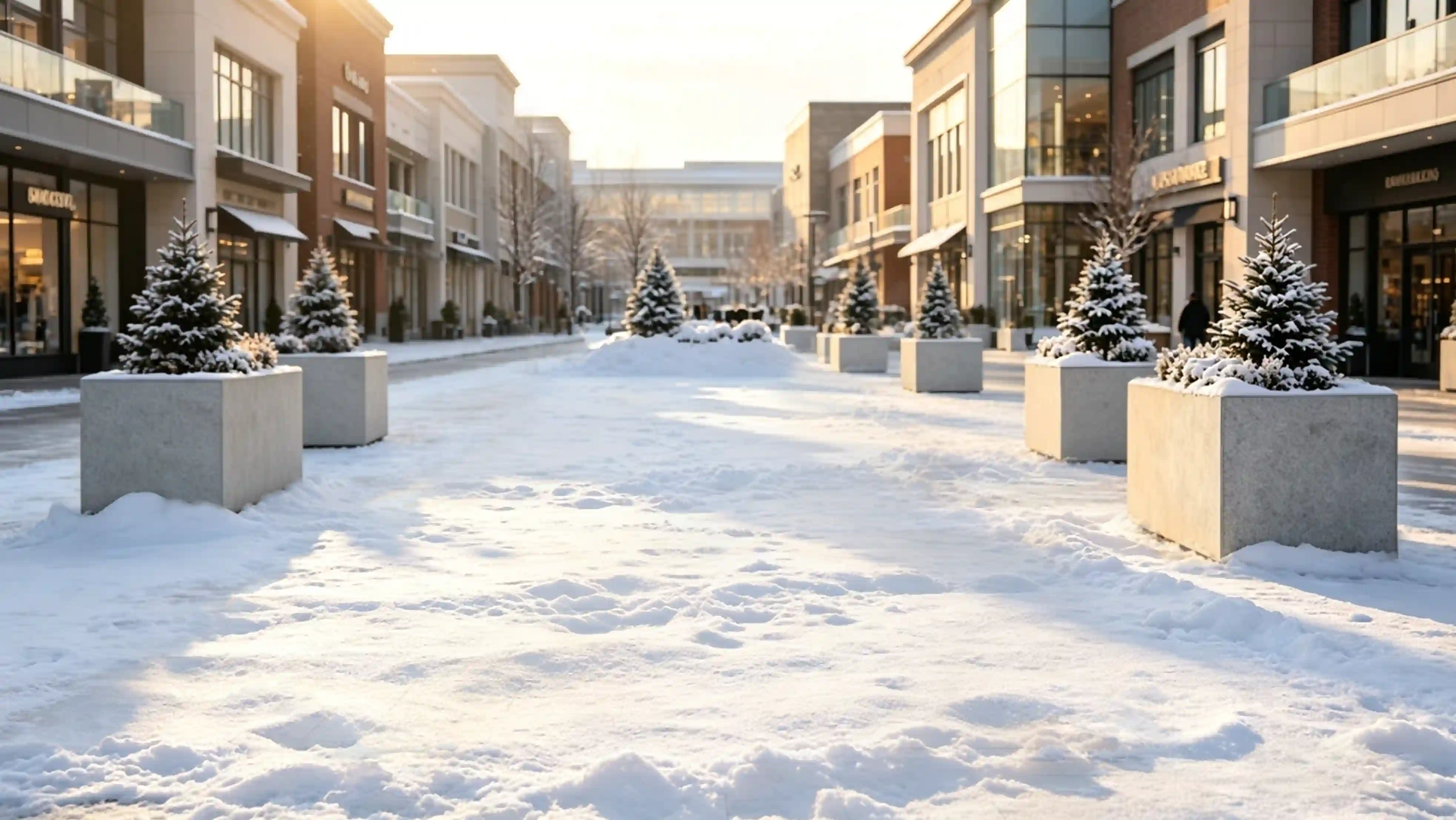
Landscape architects, contractors and procurement teams often ask for one material that can handle every climate. In practice, selecting commercial outdoor planters requires a system-level review. The vessel material matters, but so do drainage, wall geometry, finish, planting depth, exposure, installation and maintenance. This guide explains where GRC performs well, where other materials may still be suitable and which details should be confirmed before an order is approved.
1. Four Climate Risks That Affect Commercial Planters
Extreme weather does not damage every planter in the same way. Identifying the dominant exposure helps buyers compare materials and specify the right supporting details.
1. Freeze-Thaw Exposure
When a cement-based or masonry container becomes saturated, freezing water can create internal pressure. Repeated cycles may contribute to scaling, cracking or damage around the base and drainage openings.
2. UV Exposure and Heat
Sunlight can change pigments, coatings and polymer-based surfaces over time. Dark finishes, thin conductive walls and limited soil volume can also increase root-zone temperature fluctuations.
3. Prolonged Rain and Humidity
Slow drainage can leave the root zone waterlogged. Wet conditions may also encourage surface staining or biological growth and can accelerate decay in untreated or poorly maintained wood.
4. Wind and Structural Loads
Wind acts on the container and the plant canopy. On rooftops and exposed plazas, the design must consider overturning risk as well as the combined load of the planter, saturated growing media, drainage layers and vegetation.
2. Comparing GRC with Other Outdoor Planter Materials
No planter material is automatically suitable for every project. GRC, also called GFRC, is a cement-based composite reinforced with alkali-resistant glass fibers. For a general definition, see this overview of Glass Fiber Reinforced Concrete. The practical comparison below focuses on specification trade-offs rather than universal rankings.
Plastic and Resin Planters
Where they fit: Plastic and resin containers can be economical, easy to move and practical where low weight is the main priority.
What to check: Cold-temperature impact performance, UV stabilization, wall thickness, color stability and ballast requirements vary substantially by formulation and product quality. A generic “plastic” label is not enough for an exposed commercial specification.
Metal Planters
Where they fit: Properly fabricated metal planters provide crisp profiles and can suit contemporary commercial landscapes.
What to check: Metal conducts heat efficiently, so finish color, insulation or liners, soil volume and irrigation deserve attention in hot locations. The metal type, joints, protective finish and site salinity also affect corrosion planning.
Fiberglass (FRP) Planters
Where they fit: FRP can deliver low weight, smooth surfaces and broad shape flexibility, which may be useful where access or structural load limits are strict.
What to check: Resin system, laminate quality, gelcoat or paint specification, UV exposure, impact risk and future refinishing. FRP and GRC both contain glass reinforcement, but FRP uses a polymer resin matrix while GRC uses a cementitious matrix; they should not be described as the same material.
Wood Planters
Where they fit: Wood offers a warm appearance and can suit protected hospitality, residential and seasonal installations.
What to check: Species, treatment, liner design, drainage, ground contact and a realistic inspection and resealing schedule. In persistently wet climates, the maintenance requirement should be assessed before purchase.
Where GRC Fits
GRC combines a cementitious appearance with AR glass-fiber reinforcement and can be formed in project-specific sizes, shapes and finishes. Compared with solid conventional concrete, a properly designed GRC shell can reduce material mass while retaining the visual character of concrete. It remains heavier than many plastic or FRP alternatives, which can be an advantage or a constraint depending on the site.
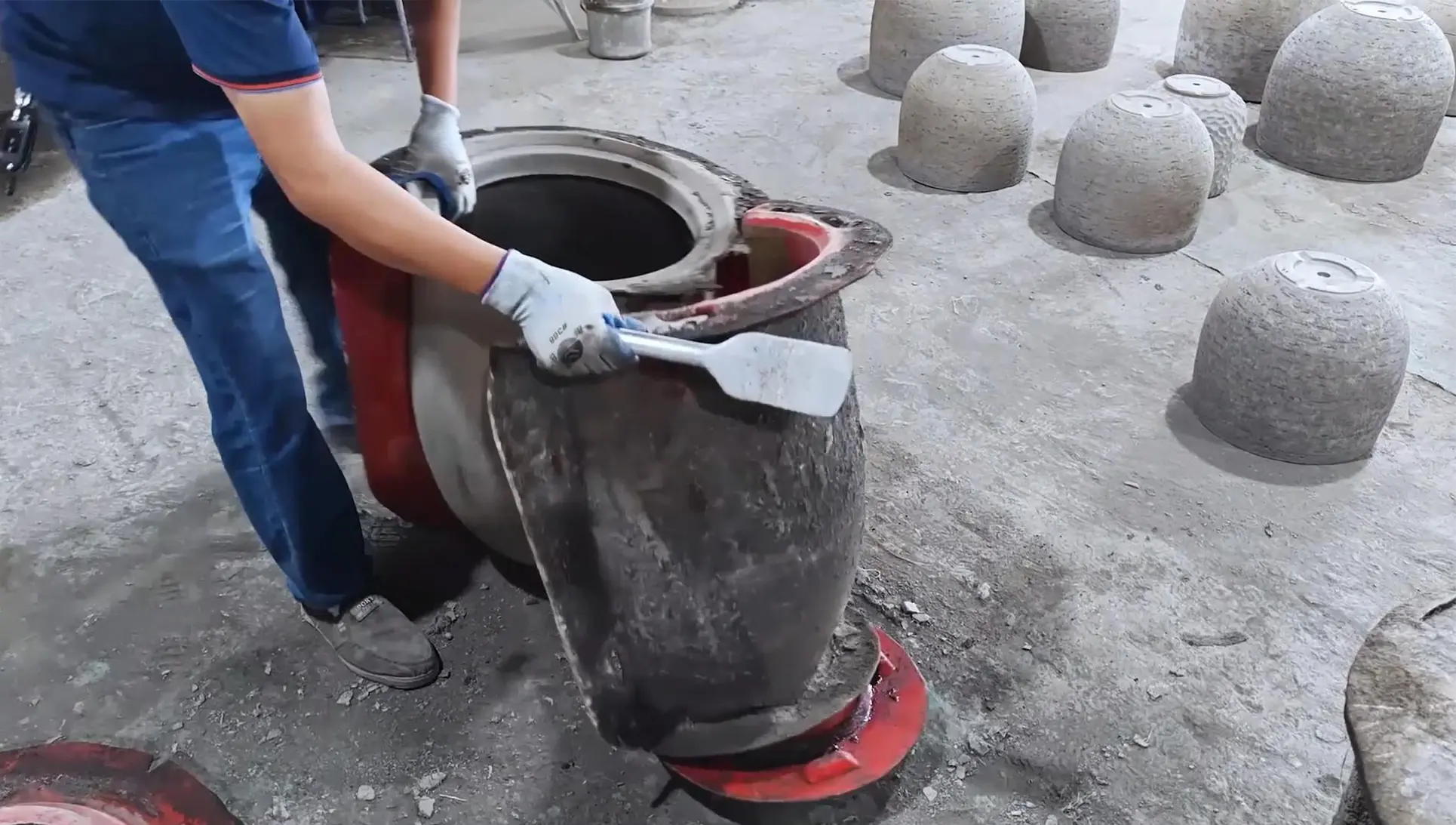
Ronglin's production uses pre-mixed chopped AR glass fibers, while the application method is adapted to the mold geometry and production difficulty. Buyers who want to understand this relationship can review how GRC planters are made and checked before shipment.
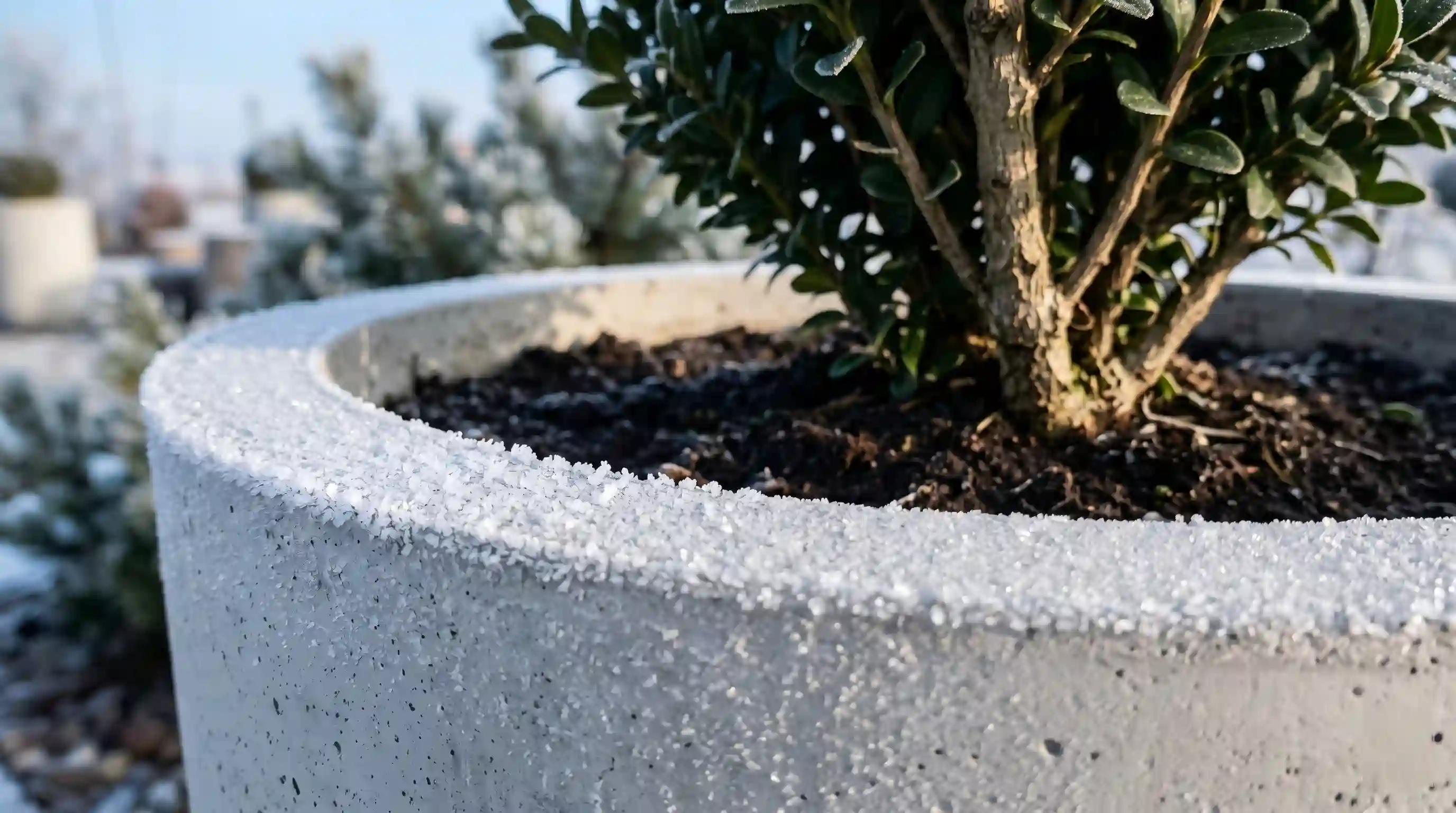
3. Cold-Climate Planters: What “Frost-Proof” Should Mean
“Frost-proof planter” is a useful search term, but it should not be treated as a guarantee based on material name alone. For cement-based containers, the risk increases when the body or base remains saturated and water freezes repeatedly.
AR glass fibers help reinforce the cementitious matrix, but they do not replace control of the mix, application, compaction, curing and drainage. The planting assembly also needs a clear route for water to leave the container rather than collect at the base.
Specify together: intended temperature exposure, outdoor drainage openings, clearance below outlets, base details, finish requirements and winter maintenance. If a project requires a defined freeze-thaw performance standard, request documented test criteria for the exact product specification instead of relying on a general marketing label.
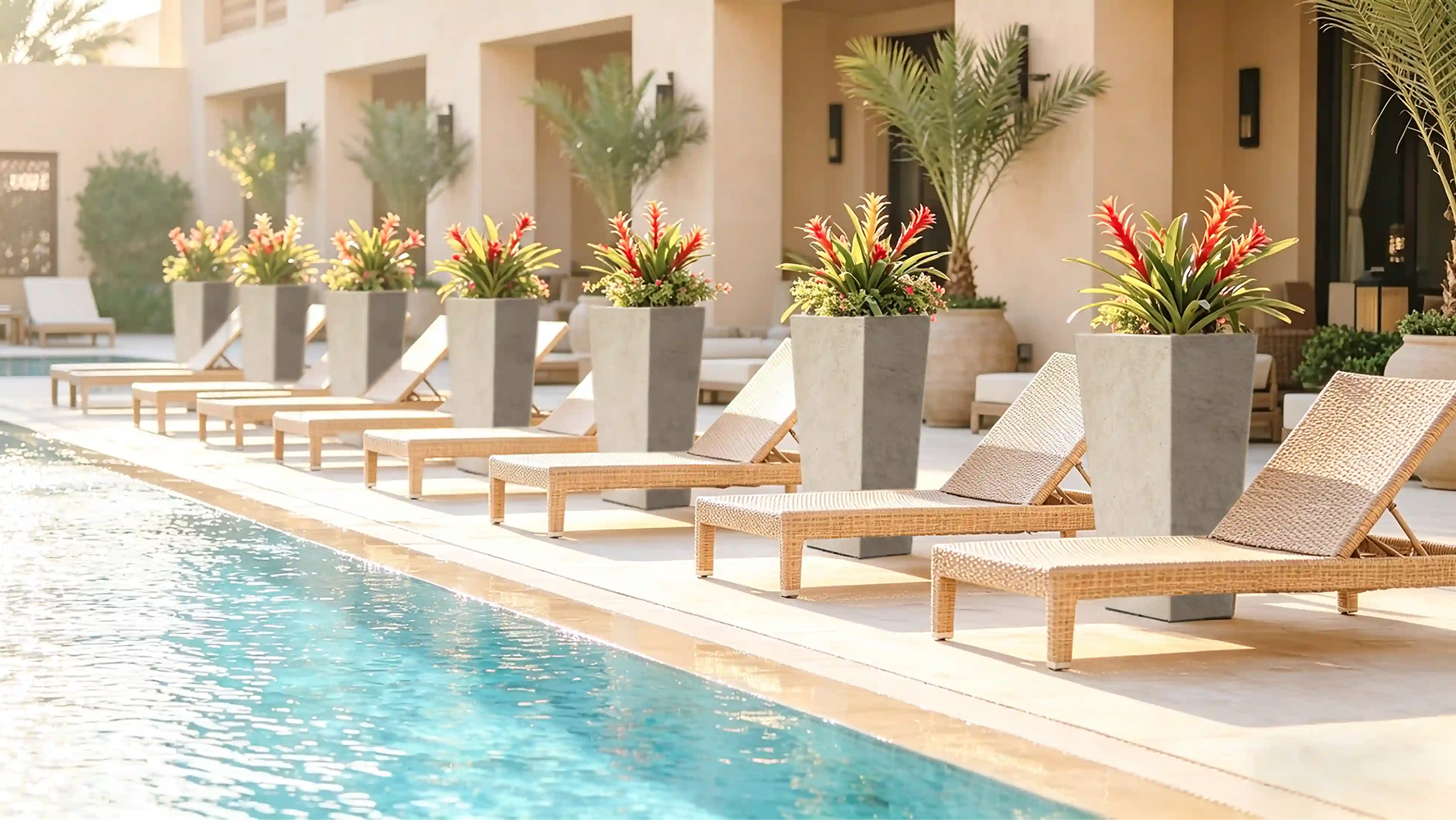
4. Planters for Strong Sun and High Temperatures
GRC's cementitious body does not soften in heat in the same way as a thermoplastic container. Its mass can also slow short-term temperature changes, but GRC should not be described as thermal insulation and it cannot by itself prevent root-zone overheating.
Surface color, wall geometry, planter volume, air circulation, growing media, plant selection and irrigation all affect heat exposure. Dark finishes generally absorb more solar energy than light finishes, regardless of the base material.
Specify together: an exterior finish appropriate for the intended UV exposure, an approved color or sample, acceptable natural variation and realistic cleaning or refinishing expectations. Coating type and performance should be confirmed for each order rather than assumed for every Ronglin finish.
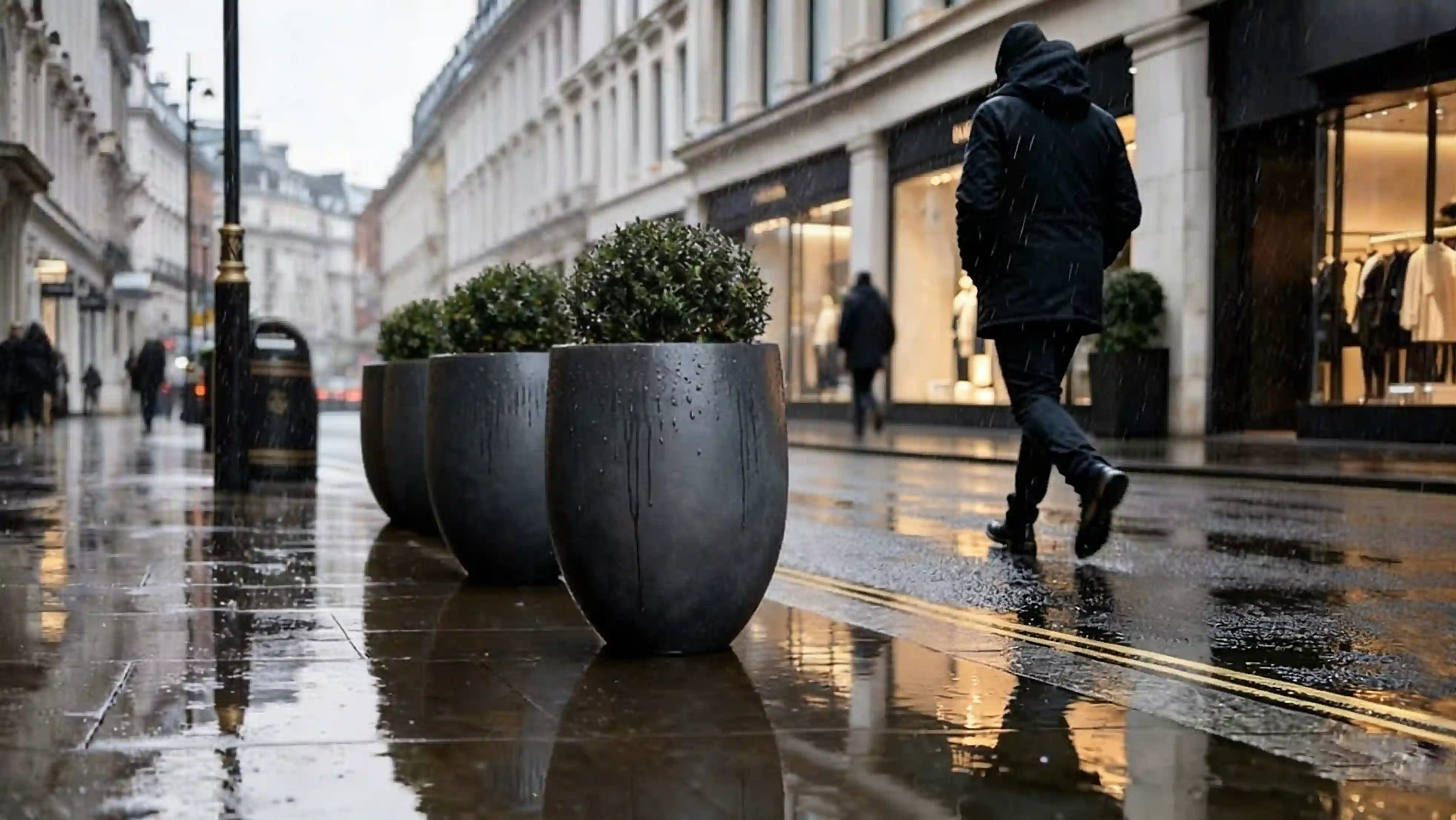
5. Planters for Heavy Rain and Humid Climates
Because GRC is an inorganic cement-based composite, the planter body does not rot like wood. That advantage does not make the complete planting system immune to staining, biological growth or poor moisture management.
Drainage holes allow excess water to leave, while internal geometry and false bottoms can be customized for the application. However, no planter material or drainage hole can independently prevent root rot. Growing media, outlet clearance, irrigation, rainfall, plant selection and maintenance remain part of the solution.
For design options and limitations, review Ronglin's guide to commercial planter drainage systems and false bottoms.
“An all-weather planter specification is not a single material label. It is the coordination of material, geometry, drainage, finish, installation and maintenance.”
6. Climate-Adaptive Planter Selection Matrix
Use this matrix as a procurement starting point. Final requirements should be based on the specific product, planting design and site conditions.
| Exposure | Primary Risks | Specification Priorities | GRC Project Note |
|---|---|---|---|
| Freezing Winter | Saturation, freeze-thaw cycling and blocked outlets | Mix and curing control, drainage, base clearance and documented test requirements where applicable | AR fiber reinforcement supports the cementitious matrix; drainage and moisture control remain essential. |
| Strong Sun and Heat | Finish change, heat gain and root-zone stress | Color, exterior finish, soil volume, irrigation and maintenance expectations | The cementitious body is heat-stable, but coating and planting-system details still govern field performance. |
| Heavy Rain and Humidity | Waterlogging, staining and biological growth | Outlet size and position, internal geometry, growing media, irrigation and cleaning access | The inorganic body will not rot like wood; it still requires a coordinated drainage and maintenance plan. |
| High Wind or Rooftop | Overturning, windborne debris and structural loading | Wind assessment, canopy area, planter geometry, saturated weight, ballast or anchoring and roof load capacity | GRC weight may improve stability versus very light containers, but project-specific engineering is still required. |
7. What Commercial Buyers Should Confirm
Before approving a planter for a demanding site, give the manufacturer and project team enough information to review the complete application:
- Site exposure: temperature range, sun orientation, rainfall, salinity and wind conditions.
- Planting load: planter size, growing-media depth, saturated weight and mature plant canopy.
- Water management: drainage holes, outlet clearance, false-bottom requirements and irrigation method.
- Finish: color, texture, sealant or coating requirement, approved sample and maintenance expectations.
- Installation: access route, lifting method, base support and any ballast or anchoring design.
- Evidence: request product-specific drawings, samples or test criteria when the project specification requires them.
For exposed roofs, suspended slabs or unusually large containers, also review the engineering considerations for large planters on rooftops and sunken plazas. The planter's self-weight should never be treated as a substitute for a wind or structural assessment.
Commercial Outdoor Planter FAQs
Are GRC planters frost-proof?
GRC can be specified for cold outdoor environments, but “frost-proof” should not be treated as an unconditional promise. Performance depends on the exact formulation, application, curing, moisture exposure, drainage, finish, installation and maintenance. Where a project requires a defined freeze-thaw rating, ask for evidence that applies to the proposed product.
Do commercial GRC planters fade in direct sunlight?
The cement-based body does not fade in the same way as a colored plastic body, but pigments, stains, sealers and coatings can change with weathering. Specify the finish for the expected UV exposure and confirm the approved color, sample and maintenance requirements for the order.
Can drainage holes prevent root rot?
Drainage holes help excess water escape, but they cannot independently prevent root disease. Outlet clearance, internal geometry, growing media, irrigation frequency, rainfall, plant selection and maintenance all influence root-zone moisture.
Are GRC planters suitable for rooftops and windy sites?
They can be, but suitability is project-specific. GRC is generally heavier than plastic or FRP and lighter than a comparable solid-concrete container. A rooftop specification should still account for roof load capacity, saturated planting weight, wind pressure, plant canopy, planter geometry and any required ballast or anchoring.
Discuss an All-Weather Planter Specification
Share the project location, planter dimensions, finish direction, planting requirements and installation conditions. Ronglin can then review the GRC body, drainage details and production route for the intended application.
Materials and Styles: Tall Modern Outdoor Planters for Your Home