Tall Modern Outdoor Planters in Commercial Landscaping: 8 Design Strategies

A practical design guide to using tall modern outdoor planters for entrances, circulation routes, privacy, spatial zoning and commercial landscape projects.
Design Summary: What Tall Planters Can—and Cannot—Do
- Create vertical emphasis: Tall planters can relate planting to doors, columns and high façades without requiring permanent in-ground beds.
- Organize open space: Repeated containers can define seating, waiting and circulation areas while preserving a layout that can be adjusted later.
- Support visual screening: The planter, mature plant canopy and spacing must be designed together; vessel height alone does not create privacy.
- Require technical coordination: Stability, saturated planting weight, drainage, access and maintenance should be confirmed before size and placement are approved.
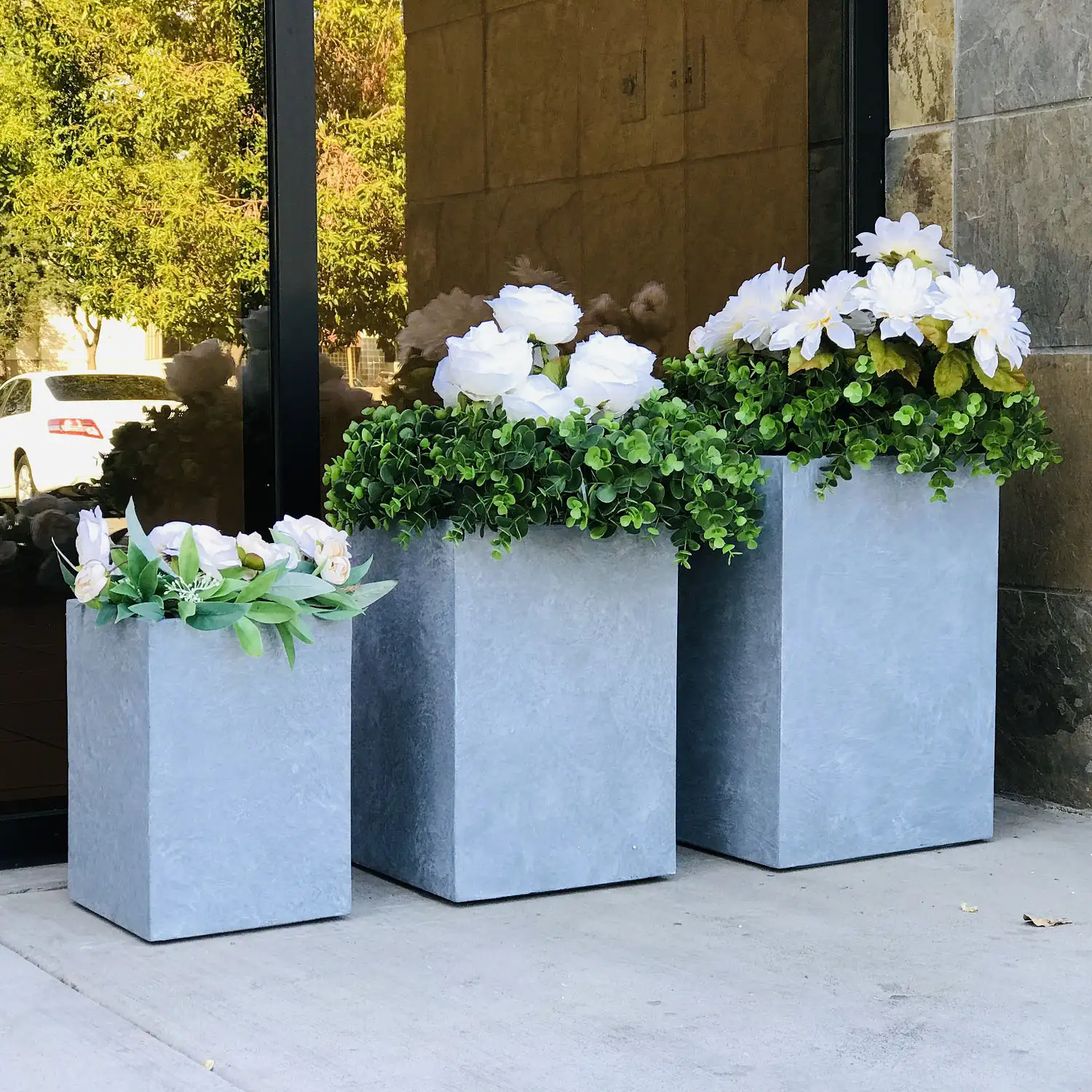
Tall modern outdoor planters are most effective when they solve a spatial problem rather than serve as isolated decoration. In hotels, retail environments, offices, mixed-use developments and residential amenity areas, they can frame an arrival, soften a hard edge or separate activities without building a permanent wall. The selection process should therefore start with the site, circulation and planting intent—not only with the planter's appearance. Ronglin's collection of commercial pots and planters can be reviewed after the required scale, geometry and technical conditions are defined.
1. Why Tall Planters Work in Commercial Landscapes
A tall planter introduces both a vertical object and a raised planting plane. That combination changes how people perceive a space, but its value depends on proportion, repetition and placement.
Vertical Emphasis
The raised plant canopy can relate to architectural features that low bowls or groundcover planting may not reach. This is useful beside entrances, columns and long façades.
Space Definition
A line or cluster of planters can mark the edge of a dining, waiting or lounge zone while keeping the layout visually open and potentially relocatable.
Visual Screening
Tall vessels raise dense foliage to eye level. Effective screening still depends on planter spacing, plant width, seasonal density and the desired sightline.
Repeatable Rhythm
Repeating one shape, finish or planting palette can connect separate areas of a property and create a consistent visual language across the site.
2. Eight Practical Layout Ideas for Tall Modern Outdoor Planters
1. Frame an Entrance Without Restricting It
A pair of tall planters can mark the main door, gate or reception approach. Symmetry communicates formality, while different heights create a more relaxed composition. Keep door swings, emergency egress, accessible routes and maintenance access clear; the planter should reinforce the entrance rather than narrow it.
2. Clarify a Circulation Route
Planters placed at decision points can help people read the intended path through a courtyard or terrace. Use a consistent spacing rhythm and preserve required clear widths. A continuous row is not always necessary; a few well-positioned markers can guide movement with less visual clutter.
3. Define Outdoor Dining and Lounge Zones
Rectangular or repeated tall planters can separate seating from adjacent pedestrian movement without making guests feel enclosed. Confirm that foliage will not interfere with chairs, servers or sightlines and leave enough access for watering, pruning and cleaning.
4. Build a Modular Privacy Screen
Combine tall containers with upright or dense planting where a visual buffer is needed around patios, pool areas or property edges. Specify the mature plant width and spacing before selecting the planter count. On exposed sites, remember that dense foliage also increases the area acted on by wind.
5. Break Up a Long Façade or Blank Wall
A repeated group can introduce scale and planting along a hard building edge where permanent beds are impractical. Relate planter spacing to doors, windows, structural bays or lighting so the arrangement feels connected to the architecture rather than added afterward.
6. Resolve Empty Corners and Level Changes
Tall forms can balance columns, stair landings and oversized corners, but they should not obstruct guardrails, handrails or visibility. Use a planter height that complements the nearby architectural feature instead of competing with it.
7. Create a Coordinated Cluster
Instead of repeating identical pieces, combine two or three compatible heights or footprints. Keep one unifying element—such as finish, shape family or plant palette—so the group reads as a deliberate composition. Check that every planter remains reachable after installation.
8. Connect Indoor and Outdoor Spaces
Repeating a related planter form or finish on both sides of a glazed entrance can strengthen visual continuity. Indoor and outdoor installations may require different drainage, floor protection and finishes, even when the planters appear to belong to the same collection.
3. Match Planter Proportion to the Space
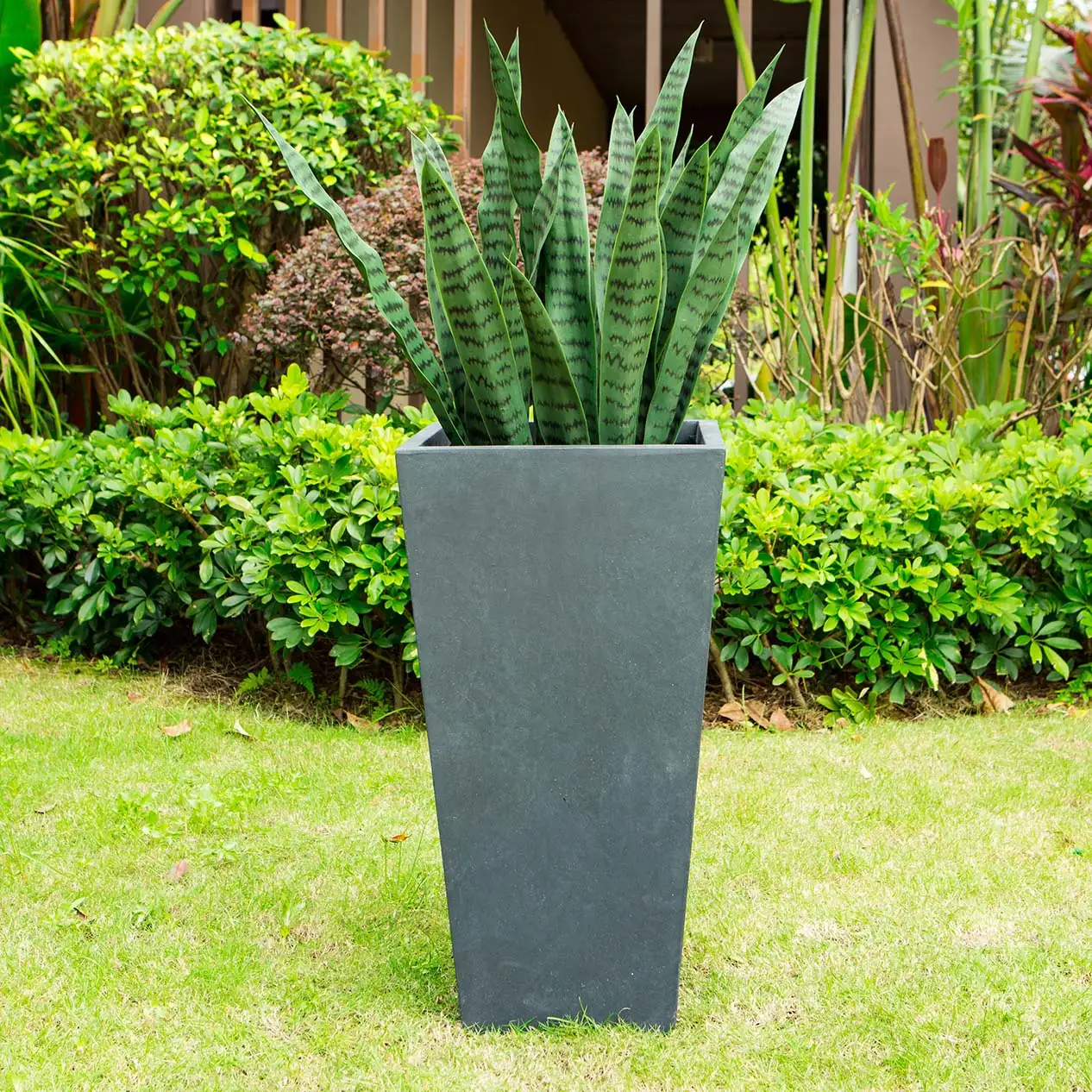
A tall planter should be evaluated as a combined composition of vessel and mature plant. A narrow container can suit a constrained location, but the base still needs enough footprint and root volume for the selected planting.
Use nearby doors, furniture, columns and façade modules as scale references. In a large plaza, one undersized planter can appear incidental; at a narrow entrance, an oversized pair can interrupt circulation and dominate the storefront.
Review before approval: planter height and width, opening size, internal planting depth, mature canopy, eye-level sightlines and the clearance required around the completed installation.
| Design Objective | Useful Arrangement | Critical Check |
|---|---|---|
| Formal arrival | Symmetrical pair or repeated entrance rhythm | Door swing, accessible route, egress and sightlines |
| Flexible zoning | Linear group beside seating or dining | Service access, chair movement and future relocation |
| Visual privacy | Closely coordinated vessels with dense upright planting | Mature canopy width, seasonal density and wind exposure |
| Architectural accent | Single statement planter or staggered cluster | Scale relationship, stability and maintenance reach |
4. Select the Material for the Site—not Only the Look
Tall planters amplify material decisions because their exposed surface area and center of mass are greater than those of low bowls. Material selection should account for appearance, handling, weather, impact exposure, maintenance and the required planted weight.
Where Tall GRC Planters Fit
GRC, also called GFRC, combines a cementitious matrix with alkali-resistant glass-fiber reinforcement. A properly designed shell can provide the visual character of concrete with less mass than a comparable solid cast-concrete vessel. It will normally remain heavier than many plastic or FRP alternatives, especially after soil and plants are added.
GRC can be useful where a project requires custom geometry, concrete-like surfaces and a more substantial installed presence. Its suitability still depends on the exact size, wall design, manufacturing control, drainage, finish, transportation route and site conditions.
FRP may be appropriate where very low container weight or complex smooth shapes are priorities. Metal can provide thin, precise profiles but requires attention to heat transfer, corrosion and finish performance. Terracotta and ceramic may suit protected or smaller-scale applications, although impact and cold-weather exposure should be assessed. For a fuller comparison, review how to select commercial outdoor planters for extreme weather.
5. Coordinate Stability, Weight and Installation
A tall planter is not automatically mobile or stable. Once filled with growing media, water and vegetation, even a nominally lightweight container may require planned lifting equipment. At the same time, a narrow vessel with a large plant canopy can be vulnerable to overturning in an exposed location.
- Confirm the complete load: include the vessel, saturated growing media, drainage components and mature plant—not only the empty planter weight.
- Review the base: footprint, taper, support surface and contact points affect stability and load distribution.
- Account for wind: plant height and canopy density can influence overturning forces as much as planter height.
- Plan installation: check door widths, lifts, corridors, paving capacity, lifting points and final maintenance access before production.
- Use project-specific engineering: rooftop, elevated, public-safety or unusually exposed installations may require structural and wind review by the responsible project professionals.
For suspended slabs and unusually large containers, see the project considerations for large planters on rooftops and sunken plazas.
6. Design Drainage as Part of the Planting System
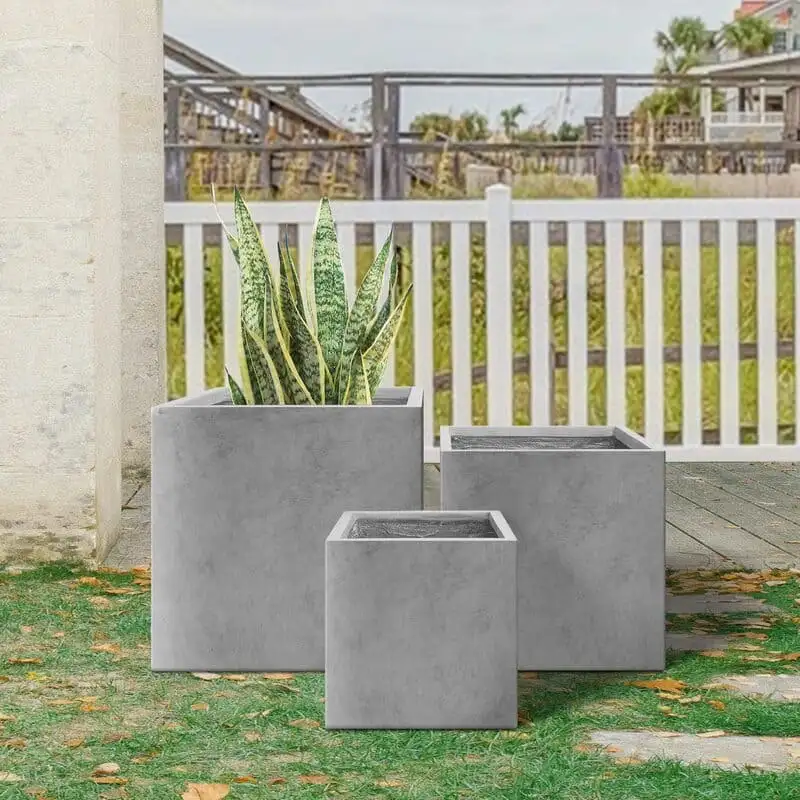
Outdoor planters exposed to rain generally need a clear route for excess water to leave. Drainage openings must remain unobstructed after the planter is positioned, and runoff should be directed so it does not create stains, slipping hazards or damage to adjacent finishes.
A layer of gravel is not a substitute for drainage holes and does not automatically improve root-zone drainage. Growing media, planting depth, outlet position, internal geometry, irrigation and local rainfall should be coordinated as one system.
For large commercial vessels, false bottoms can reduce unnecessary soil volume or support project-specific internal arrangements, but their design depends on indoor or outdoor use. Review Ronglin's guide to commercial planter drainage and false-bottom options.
7. Match the Planting to the Planter and Microclimate
The best planting is not simply the tallest plant available. The container and vegetation should remain balanced at installation and as the plant matures.
For Structure
Use upright foliage, compact shrubs or appropriately scaled small trees where year-round form is required. Check mature roots and canopy rather than relying on the nursery size alone.
For Screening
Select plants that retain the necessary density at the required height. Consider seasonal leaf loss, pruning access and how wind passes through the mature canopy.
For Seasonal Color
Use a restrained palette that can be replaced without disturbing the main structural planting. Maintenance frequency and replacement access should be agreed in advance.
For Harsh Exposure
Match plants to sun, shade, wind, temperature and irrigation availability at the exact location. The planter cannot compensate for a plant that is unsuitable for the site.
“A successful tall-planter composition coordinates the vessel, mature planting, circulation, drainage and maintenance as one landscape element.”
8. A Pre-Order Checklist for Tall Commercial Planters
| Information to Confirm | Why It Matters |
|---|---|
| Location and design purpose | Determines whether the planter is framing, zoning, screening or acting as a focal point. |
| Planter dimensions and opening | Controls external proportion, root space, planting access and visual balance. |
| Mature plant and saturated load | Affects stability, structure, handling and the final center of mass. |
| Drainage and irrigation | Prevents the planter from being specified separately from its water-management system. |
| Finish sample and weather exposure | Aligns color, texture, natural variation and maintenance expectations. |
| Delivery and installation route | Confirms access widths, lifting method, timing and the feasibility of final placement. |
Tall Modern Outdoor Planter FAQs
Are tall outdoor planters suitable for narrow entrances?
They can be, provided the planter footprint, mature foliage and required circulation clearance are reviewed together. A slim visual profile does not remove the need for an adequate base, root volume and accessible path.
Can tall planters be used as privacy screens?
Yes, but privacy comes from the combined height, width and density of the mature planting and the spacing between vessels. The design should also account for seasonal changes, pruning and wind exposure.
Should gravel be placed at the bottom for drainage?
Gravel does not replace a functioning drainage outlet and should not be presented as a universal drainage solution. The correct assembly depends on outlet position, internal structure, growing media, irrigation and plant requirements.
Are tall GRC planters easy to move?
An empty GRC shell can weigh less than a comparable solid-concrete planter, but the completed planted assembly may still be heavy. If future relocation is expected, lifting access, equipment, base protection and the planting method should be planned before installation.
Plan a Tall Planter Layout for Your Project
Share the site type, intended placement, approximate dimensions, planting direction, finish reference and installation conditions. Ronglin can review whether an existing GRC planter family or a custom production route is more appropriate.
Ultimate Guide to GRC Planter Pots: Scale & Customization